13 places found

Rumi Darwaza
An imposing 60-foot tall gateway built in 1784, the Rumi Darwaza stands as the signature symbol of Lucknow. Modeled after the Sublime Porte in Istanbul, this massive Awadhi structure marks the entrance to the old city.
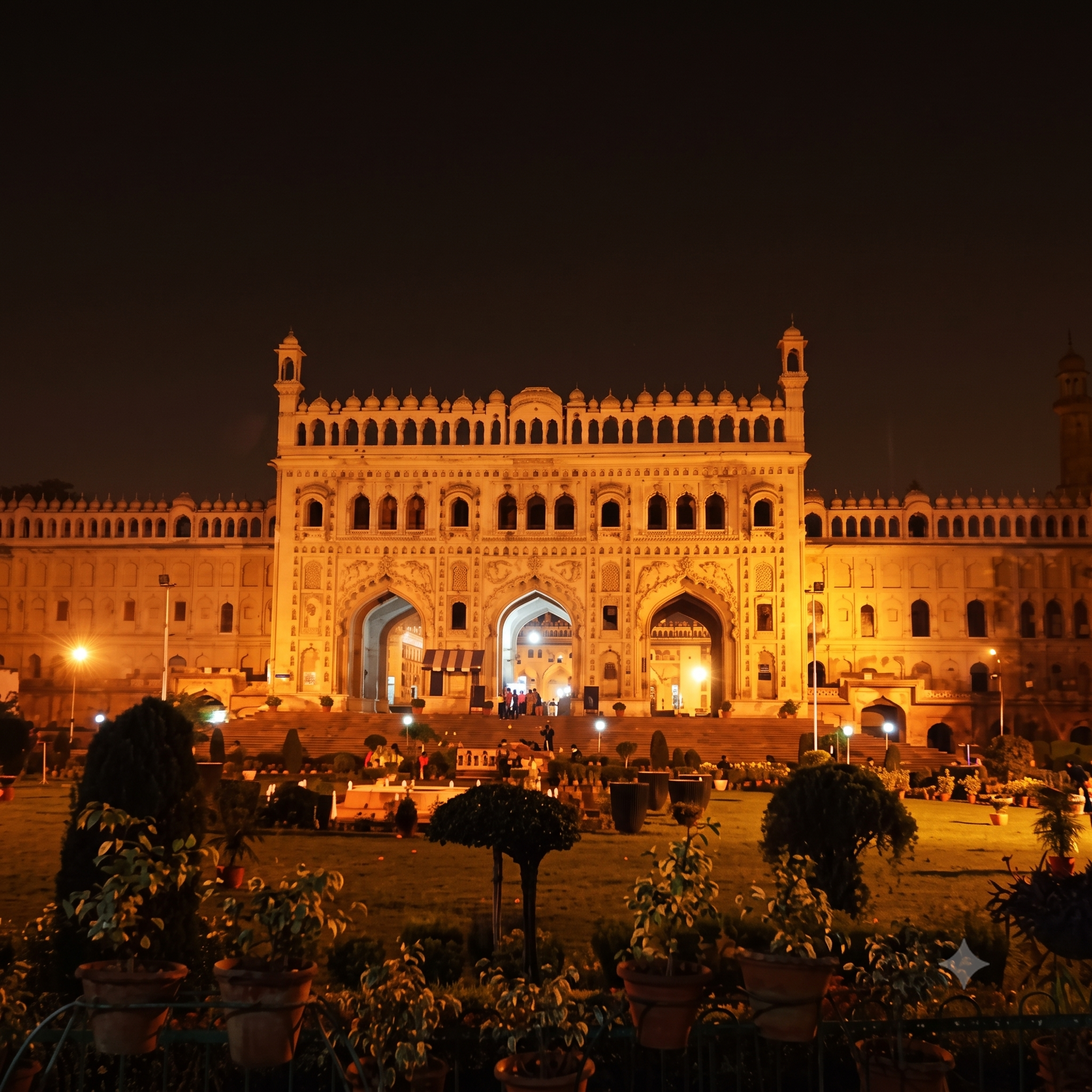
Bara Imambara
Built by Nawab Asaf-ud-Daula in 1784, the Bara Imambara is an architectural marvel of Lucknow. It is famous for its incredible 'Bhool Bhulaiya' (a massive, intricate labyrinth) and the central hall which is the largest arched hall in the world built without any external support beams.

La Martiniere College (Constantia)
Originally constructed as 'Constantia', a sprawling country mansion for Major General Claude Martin, this monumental building is now one of India's most prestigious schools. It features a unique, wildly eclectic blend of European and Indian architectural styles.

Jama Masjid, Lucknow
Built entirely with yellow sandstone, this breathtaking mosque features intricate carvings and Hindu-Muslim architectural styles. Initiated by Muhammad Ali Shah in 1839, its massive pillars and beautiful stucco work make it a masterpiece.

Chota Imambara
Known as the Palace of Lights, the Chota Imambara is an ornate congregation hall built in 1838 by Nawab Muhammad Ali Shah. Its stunning facade, filled with intricate calligraphy, and the extravagant interior adorned with Belgian crystal chandeliers make it exceptionally beautiful.

The British Residency
A group of several historically significant buildings in ruins. The Residency was the site of the Siege of Lucknow during the 1857 First War of Indian Independence. Today, the bullet-scarred ruins stand in peaceful, manicured gardens, serving as a poignant historical monument.

Shah Najaf Imambara
Constructed by Nawab Ghazi-ud-Din Haider in the early 19th century, this white-domed structure serves as his mausoleum. Modeled after the tomb of Ali in Iraq, it sits peacefully by the banks of the Gomti river.

Husainabad Clock Tower
Standing at an impressive 221 feet, the Husainabad Clock Tower is the tallest clock tower in India. Built in 1881, it reflects stunning Victorian-Gothic architecture mixed with Moorish elements, showcasing the grand vision of Awadh's rulers.

Dilkusha Kothi
The ruins of an 18th-century house built in the English baroque style by a British resident for the Nawabs of Awadh. Once a hunting lodge and summer resort, the hauntingly beautiful ruins are now surrounded by expansive lawns.
Tomb of Saadat Ali Khan
The elegant twin tombs of Nawab Saadat Ali Khan and his wife Khurshid Zadi stand as fine examples of Awadhi architecture. With their striking striped domes and well-maintained lawns, these mausoleums are incredibly photogenic.

Chattar Manzil
Also known as the Umbrella Palace due to its distinctive umbrella-shaped domes, this historical building served as a palace for the rulers of Awadh and their wives. It beautifully blends Indo-European architectural styles.
Sikandar Bagh
Originally a villa and garden enclosed by a fortified wall, it was the site of a fierce battle during the 1857 uprising. Today, only the impressive gateway and sections of the wall remain, serving as a monument to history.
Satkhanda
An incomplete, four-storied watchtower and observatory located near the Husainabad Clock Tower. Designed to be seven stories high (hence the name), construction was halted after the death of Nawab Muhammad Ali Shah.